Menu
Log in


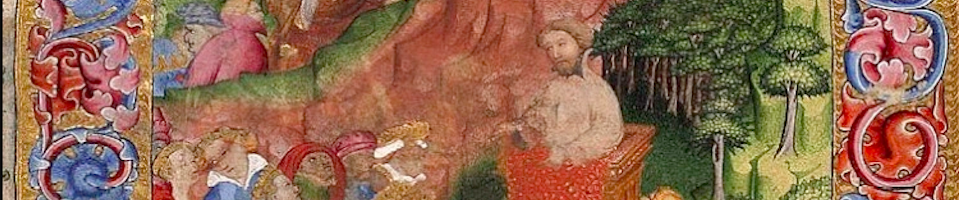
Detail from a medieval manuscript illustration, showing a bearded man at a pulpit speaking to a gathered crowd. MS 61, fol 1v, Corpus Christi College, Cambridge

News and Announcements

<< First  < Prev   1   2   3   4   5   ...   Next >  Last >> 
  • 11 Nov 2026 4:04 PM | Richard Pollard (Administrator)

    John Osborne seated in the cortile of the BSR

    (le français suit)

    It is with great sadness that we report the passing of John Osborne, past president and long-time member of the CSM, on 10 November 2026.

    John was born in Montreal in 1951.  Son of Robert E. Osborne and Beverly K. Osborne, he had a somewhat peripatetic childhood, living on both sides of the Atlantic, before his family settled in Ottawa in the late 1960s.  His father was a minister, but also a beloved New Testament professor at Carleton University, where he was one of the most popular professors on campus.  To this day, there are two Robert E. Osborne awards at Carleton, one endowed by John himself in 2009.

    John’s path in life was set in 1970 when, encouraged by his grandmother, he took a trip to Venice.  This visit informed John’s fascination with the intersection between Western and Byzantine cultural traditions, and enticed John down the perilous path of art history. He took a BA in art history at Carleton in 1973, then moved to Toronto for his MA in mediaeval studies.  He then left to study for a PhD at the Courtauld Institute in London.  He completed it while spending a year (1978–1979) as Rome Scholar at the British School at Rome, an institution, and a city, that have forever after held an important place in John’s life and heart. 

    Stuck in Rome, with no idea about what he would do in the future, he wrote to every art history department in Canada asking about a job.  Only three replied.  One was the University of Victoria, which seems to have been impressed by his comments about the title of their department: “History in art”, rather than “History of art”.  John got a job with no interview, and would remain at Victoria for more than 20 years.  Then to Queen’s, where he was head of department, before returning to Carleton in 2005 as Dean of the Faculty of Arts and Social Sciences.  When he was asked to choose his professorial title to go alongside his deanship, he very deliberately chose “Professor of Medieval Studies”.  He served as dean until 2015 and, following his retirement in 2017, held the titles of Distinguished Research Professor and Dean Emeritus.

    John was a prolific scholar.  He authored, translated, or edited 13 books, and published more than 60 articles and chapters.  Some of these articles have appeared in Byzantion, PBSR, RACAR, Mediaeval Studies, Early Medieval Europe, Frühmittelalterliche Studien, and our own Florilegium.

    John’s scholarly success was underlined by many honours.  He was named an honorary fellow of his dear British School at Rome in 2006, and in 2018 he held its prestigious Balsdon Fellowship.  He won the CSM’s Margaret Wade Labarge Book Prize in 2021 for Rome in the Eighth Century: A History in Art (Cambridge, 2020).  And though it is both an honour and a duty, we should note that John served as president of the CSM from 2012 to 2014 and served on many of its prize committees as well.

    John was a great scholar, but much more than that. As St. Paul said, “And though I have the gift of prophecy, and understand all mysteries, and all knowledge; and though I have all faith, so that I could remove mountains, and have not charity, I am nothing”.   John was indeed not just learned and industrious, but generous and kind and helpful.  He supported and advised colleagues and younger scholars, and was an indefatigable supporter of the British School at Rome. 

    Richard Hodges, former director of the BSR (1988–95), said, inter alia, “I cannot think of anyone kinder or more collegial in offering support and guidance.  … He was always ready to encourage…. And to generously share a bottle of Sicilian red wine in the School’s cortile.  … His was always a constructive voice and one, I should add, that in the arc of forty-plus years I rank in my mind without hesitation side by side with that of Richard Krautheimer”.   

    Rosamond McKitterick, professor emerita of medieval history at Cambridge, who died on June 13th this year, perhaps captured John most succinctly and best: “he is such a dear, kind, generous, good and civilised man as well as an excellent scholar”.

    Perhaps that is all that needed to be said.  The Society will dearly miss John, but we will not forget him. 

    - Richard M. Pollard 

    If you would like to hear more from John, please listen to these interviews, conducted in 2021 and 2025.


    =====================

    C’est avec une grande tristesse que nous annonçons le décès de John Osborne, ancien président et membre de longue date de la Société canadienne des médiévistes (SCM), survenu le 10 novembre 2026.

    John est né à Montréal en 1951. Fils de Robert E. Osborne et de Beverly K. Osborne, il a connu une enfance quelque peu nomade, vivant de part et d’autre de l’Atlantique, avant que sa famille ne s’installe à Ottawa vers la fin des années 1960. Son père était pasteur, mais aussi un professeur de Nouveau Testament très aimé à l’Université Carleton, où il comptait parmi les enseignants les plus populaires du campus. Il existe encore aujourd’hui deux bourses Robert E. Osborne à Carleton, dont l’une a été créée grâce à un don de John lui-même en 2009.

    John a trouvé sa voie en 1970 lorsque, encouragé par sa grand-mère, il a fait un voyage à Venise. Ce séjour a nourri sa fascination pour la rencontre entre les traditions culturelles occidentales et byzantines, et l’a entraîné sur le périlleux chemin de l’histoire de l’art. Il a obtenu un baccalauréat en histoire de l’art à Carleton en 1973, puis est parti à Toronto pour y faire une maîtrise en études médiévales. Il est ensuite allé préparer un doctorat au Courtauld Institute de Londres. Il l’a terminé au cours de son année comme boursier (1978–1979) à la British School at Rome, une institution qui, tout comme la ville elle-même, allait garder une place importante dans sa vie et dans son cœur.

    Coincé à Rome, sans trop savoir ce qu’il allait faire de sa vie, il a écrit à tous les départements d’histoire de l’art du Canada pour demander s’ils avaient un poste à lui offrir. Trois seulement ont répondu. L’un d’eux, à l’Université de Victoria, semble avoir été impressionné par ses remarques sur le nom du département : « Histoire dans l’art », plutôt qu’« Histoire de l’art ». John a obtenu un poste sans même passer d’entrevue, et il est resté à Victoria pendant plus de 20 ans. Puis ce fut Queen’s, où il a été directeur de département, avant son retour à Carleton en 2005 comme doyen de la Faculté des arts et des sciences sociales. Lorsqu’on lui a demandé de choisir le titre professoral qui accompagnerait son décanat, il a très délibérément choisi celui de « professeur d’études médiévales ». Il est resté doyen jusqu’en 2015 et, après sa retraite en 2017, a porté les titres de professeur de recherche distingué et de doyen émérite.

    John était un chercheur prolifique. Il a écrit, traduit ou dirigé 13 livres, et publié plus de 60 articles et chapitres. Certains de ces articles ont paru dans Byzantion, PBSR, RACAR, Mediaeval Studies, Early Medieval Europe, Frühmittelalterliche Studien, ainsi que dans notre revue, Florilegium.

    Les travaux de John lui ont valu de nombreux honneurs. Il a été nommé membre honoraire de sa chère British School at Rome en 2006, et y a bénéficié de la prestigieuse bourse Balsdon en 2018. Il a remporté en 2021 le prix Margaret Wade Labarge de la SCM pour Rome in the Eighth Century: A History in Art (Cambridge, 2020). Et, même s’il s’agit autant d’un devoir que d’un honneur, rappelons que John a été président de la SCM de 2012 à 2014 et qu’il a également siégé à de nombreux comités d’attribution de ses prix.

    John était un grand savant, mais bien plus que cela. Comme le disait saint Paul : « Et quand j’aurais le don de prophétie, la science de tous les mystères et toute la connaissance, quand j’aurais même toute la foi jusqu’à transporter des montagnes, si je n’ai pas la charité, je ne suis rien. » John était en effet non seulement érudit et travailleur, mais aussi généreux et gentil et serviable. Il soutenait et conseillait ses collègues et les jeunes chercheurs, et était un soutien infatigable de la British School at Rome.

    Richard Hodges, ancien directeur de la BSR (1988–1995), disait, inter alia : « Je ne connais personne qui ait offert son soutien et ses conseils avec plus de gentillesse et de collégialité. … Il était toujours prêt à encourager… Et à partager généreusement une bouteille de rouge sicilien dans le cortile de l’École. … Sa voix était toujours constructive, une voix que, je dois l’ajouter, avec le recul de plus de quarante ans, je place sans hésitation aux côtés de celle de Richard Krautheimer. »

    Rosamond McKitterick, professeure émérite d’histoire médiévale à Cambridge, décédée le 13 juin dernier, a peut-être décrit John de la manière la plus juste et la plus concise : « c’est un homme si attachant, gentil, généreux, bon et civilisé, en plus d’être un excellent chercheur ».

    Peut-être est-ce là tout ce qu’il fallait dire. John manquera beaucoup à la Société, mais nous ne l’oublierons pas.

    - Richard M. Pollard


    Si vous souhaitez en savoir plus sur John, n'hésitez pas à écouter ces entretiens, réalisés en 2021 et 2025.


  • 25 Sep 2026 7:04 PM | Donna Trembinski (Administrator)

    Mary Catherine Davidson, retired associate professor of English at Glendon College, York University, passed away suddenly on September 7, 2026. Dr. Davidson received her PhD from the Centre for Medieval Studies at the University of Toronto in 2001 and taught in Kansas before being hired at Glendon College.  Her book, Medievalism, Multilingualism and Chaucer was published in 2010.  More information about Dr. Davidson can be found here. https://www.medieval.utoronto.ca/news/memoriam-mary-catherine-davidson. 

  • 25 Sep 2026 6:51 PM | Donna Trembinski (Administrator)

    Many of us will remember George Clark, Professor Emeritus of English at Queen's University, who attended the CSM Annual Conferences quite regularly. George was a specialist in Old English and Old Norse and regularly presented on texts like Beowulf and The Battle of Maldon. He was an active scholar into his nineties and long after he retired. George passed away after a brief illness on July 28, 2026 at the age of 94.  He will be missed by members of this society. More information can be found here: https://www.arbormemorial.ca/en/reid/obituaries/george-clark/165302.html

  • 25 Sep 2026 6:45 PM | Donna Trembinski (Administrator)

    The Department of History, Classics and Religion at the University of Alberta is looking for an instructor to take over two courses taught in synchronous, remote format.  The courses are Topics in Medieval History with a focus on the medieval body and Medieval England.  If interested, please contact the chair, Dr. Heather Coleman at hcoleman@ualberta.ca and send along a CV. 

  • 10 Sep 2026 11:55 AM | Anonymous

    L’Université d’Ottawa recrute une professeure adjointe ou un professeur adjoint en histoire médiévale ou transrégionale (VIIe–XVIe siècles).

    Pour de plus amples renseignements, veuillez communiquer avec :

    Dr Eric Allina
    Directeur, Département d’histoire
    Université d’Ottawa
    55, avenue Laurier Est
    Ottawa (Ontario) K1N 6N5
    Courriel : HISdir@uottawa.ca

    Pour de plus amples renseignements, voir: https://l1nq.com/x17mkiq 

    The University of Ottawa is hiring an Assistant Professor in Medieval or Transregional History (7th–16th centuries).

    For further information, please contact:

    Dr. Eric Allina
    Director, Department of History
    University of Ottawa
    55 Laurier Avenue East
    Ottawa, ON K1N 6N5
    Email: HISdir@uottawa.ca

    For more details, see University Affairs: https://sl1nk.com/op8lech


  • 1 Sep 2026 8:46 AM | Marc Cels
    Sangalli Institute Award for the Religious History 2026: in collaboration with the Department of University and Research of the Municipality of Florence, it offers to young Italian and foreign researchers (no more than 5 years since obtaining doctorate) the possibility of publishing two books concerning the religious history, from Middle Ages to the Contemporary Era, in an interdisciplinary and interreligious perspective. The essays will appear in a dedicated book series of the Firenze University Press. 

    Deadline: 1st November 2026.

    Art. 1. The purpose of the award The Sangalli Institute for the religious history and cultures, within the ‘Premio Ricerca Città di Firenze’, in collaboration with the Department of University and Research of the Municipality of Florence and with the Firenze University Press, supports no. 2 awards for the publication of unpublished and peer-reviewed monographs, in Italian, English and the other principal European languages, presented by young researchers and concerning the religious history from Middle Ages to the Contemporary Era. This initiative is intended to reach one of the goals of the Sangalli Institute, in order to support the scientific research, especially that of young researchers, fostering a wider circulation of their works by the open access publication. 
    Art. 2. The awards The awards consist of the publication of two monographs, chosen by a specific committee working through a peer-review process. The essays, without any geographical, cultural and thematic boundaries, must concern The Religious History from Middle Ages to the Contemporary Era, also intended in an inter disciplinary and inter-religious way. The two monographs will appear into the dedicated book series of the Institute and will be published and distributed both in paper and digital edition through the on line catalogue of the Firenze University Press and any other operators related to the editor, in order to spread at most their circulation. The books must have a maximum of about 300 pages (black and white photographs) and they will be provided with an ISBN number, both for the paper and the digital edition. The digital edition will be published open access and fully downloading. The authors will receive no. 25 copies free of their book. 
    Art. 3. Copyright The awarded publications will be ruled by an editorial agreement, in compliance with this call for publications. The agreement will be signed between the Firenze University Press and the author in conformance with the ‘Creative Commons Public Licenses’. 
    Art. 4. The making of the book The Firenze University Press will specify to the winners every editorial instruction in order to deliver the essay in a camera ready format. The authors will have the task of proof-reading. Art. 5. The standards and the procedure of the selection The selection will be made by a judging Committee, composed of the following professors: Marianna Ferrara (Sapienza Università di Roma) Francesco Mazzucotelli (Università degli studi di Pavia) Antonio Musarra (Sapienza Università di Roma) Maria Chiara Rioli (Università degli studi di Modena e Reggio Emilia) Maurizio Sangalli (Università per stranieri di Siena) During its first meeting, the Committee will appoint a President, a Secretary and will establish the standards of the selection which will evaluate the manuscripts. The Committee will have the possibility to take advantage of some external referees, if suitable. The Committee will operate in conformity with the standards established into the ‘Linee Guida Anvur’ for the Valutazione della Qualità della Ricerca (VQR), evaluating the contribution to the progress of the specific branch of knowledge as far as the significance and the originality, offered by the presented manuscripts. The decision of the Committee is final and their members can ask to the winners to review their essays in view of the publication. If the candidate refuses to do it, or if he/she does not achieve the approval by the Committee regarding the changes he/she has made, he/she will be deprived of the award by a simple communication of the Committee and a scroll in the merit ranking will immediately take place. The Sangalli Institute will make available its headquarters for the selection. The proclamation of the winners will be known no later than 31st December 2026. The award ranking will be published on the website and on the social pages of the Institute. Direct and personal communication of the results of the selection will be provided exclusively to the winners. 
    Art. 6. The required conditions for the admission and the application rules Ph.D. scholars who have obtained their doctorate no later than five years at the date of the publication of this call for publications can apply. Applications must be sent by 1st November 2026, esclusively by e-mail, at the following address: segreteria@istitutosangalli.it. In his/her applications, the candidate must include, under his/her responsibility, in accordance with the DPR 445/200:-- personal details, the date and the place of birth, the fiscal code, the residence and the domicile, the e-mail address and the telephone number the date of the achievement of the Ph.D., the attended School of the Doctorate and the title of the thesis, together with, if possible, the judgement of the Committee of the Doctorate Applications must include, esclusively in digital format:  an abstract of the presented manuscript (4.000 characters at most);  the text of the manuscript esclusively in digital format;  a CV, together with the necessary information to outline his/her scientific and professional profile;  a copy of a valid ID card esclusively in digital format. Any request of more information can be addressed to segreteria@istitutosangalli.it. Art. 7. The text of this call for publications will be available on the websites of the Sangalli Institute, the Municipality of Florence, the University of Florence and of the Firenze University Press and it will be publicized through the most suitable media. Art. 8. Treatment of the personal data. The personal data of the candidates will be treated according to the D.Lgs. 196/03. 
    Florence, 1st September 2026 The President of the Institute

  • 28 Aug 2026 7:23 AM | Shannon McSheffrey (Administrator)
    Le Département d’histoire de la Faculté des arts de l’Université d’Ottawa sollicite des candidatures pour un poste en histoire médiévale et/ou histoire transrégionale, 7e – 16e siècle. Ce poste menant à la permanence sera pourvu au niveau de professeure adjointe ou professeur adjoint, à compter du 1er juillet 2027.  https://www.affairesuniversitaires.ca/trouver-un-emploi/?job_id=71807 
  • 28 Aug 2026 7:19 AM | Shannon McSheffrey (Administrator)

    The Department of History at the University of Ottawa invites applications for a position in medieval and/or transregional history, 7th-16th centuries. This tenure-track appointment will be made at the assistant professor level, beginning July 1, 2027. French or English, bilingualism a substantial asset. For more details: https://universityaffairs.ca/search-jobs/?job_id=71806

  • 18 Aug 2026 2:25 PM | Shannon McSheffrey (Administrator)

    version française

    A member of the Canadian Society of Medievalists has reached a significant milestone: Joan Greatrex, author of numerous books and articles on medieval England, turned 100 years old earlier this year. Joan, who now lives in Cambridge, UK, had a long scholarly career that reached into her nineties. She is today acknowledged as the expert on English cathedral priories. 

    Joan Garlick was born in 1926 in Vineland, Ontario, near St Catharine’s, to British-born parents. She remembers several times visiting her paternal grandmother and other relatives in Britain in the 1930s. One visit to the Canterbury cathedral when she was very young was fixed in her memory; she stayed with her aunt, a physician who lived in the cathedral deanery, next to Christchurch gate. As she lay in her bedroom, the young Joan could hear cathedral choir singing. Later, as they walked around the precinct, her father pointed out discolorations in the paving stones and told her the dramatic story of the murder of Thomas Becket and his blood staining the ground – a detail that stuck in the mind of the young child. When she was about ten, she spent a year in England with her parents, attending a school where, importantly for her future, she began to learn Latin. Immediately she felt an affinity for the language’s orderliness and beauty. 

    The outbreak of war in 1939, of course, curtailed the trips to Britain for the duration of Joan’s teenage years. Had things been different, after her high school graduation she might have chosen an English university, but the war still raged when she turned eighteen, so instead in the fall of 1944 she headed to St. Hilda’s, Trinity College, at the University of Toronto. Initially intending to study medicine, she was soon distracted by her interest in English history. She remembers charismatic lecturers: Bertie Wilkinson (who would later be the first director of the Centre for Medieval Studies), G. G. Coulton (who was at U of T for the war years), Gerhart Ladner, Michael Powicke, and Marjorie Bassett all taught medieval subjects during her time at U of T. Her undergraduate studies cultivated both a fascination with the Middle Ages and a rigorous approach to its study.


    Joan's U of T Yearbook photo, 1948

    The year following her 1948 BA, Joan married Warren Greatrex, a Divinity student, in the chapel at Trinity College. Over the 1950s and 1960s, Joan and Warren had six children and moved to different parts of Canada – Toronto; Wetaskiwin, Alberta; Winnipeg; and Ottawa – as Warren took different positions in the Anglican church. Joan never lost her interest in medieval history through these peripatetic years and when they settled in Winnipeg, she began MA studies at the University of Manitoba, receiving her degree in 1962. In the mid-sixties, when the family moved to the nation’s capital, she began a PhD at the University of Ottawa. She worked under the supervision of F. R. H. DuBoulay (of Bedford College, University of London) and Leonard Boyle of PIMS. Father Boyle became a close family friend as well as a mentor: Joan remembers his frequent visits to the Greatrex family home in Ottawa and his playing on the hearth rug with their youngest son, Geoffrey (who himself is now a scholar of Late Antiquity, Professor of Classics at the University of Ottawa, and member of the CSM). Joan’s 1973 doctoral dissertation – "The Administration of Winchester Cathedral Priory in the Time of Cardinal Beaufort” – would lay the ground for her life-long interest in cathedral priories and the men who served in them.


    Joan on a medieval roof, perhaps in Canterbury? c.1972

    Both the dissertation itself and her subsequent scholarship required much research among the books and manuscripts in English libraries and archives. In the 1960s and 1970s Joan thus often travelled to England, bringing her children with her when necessary. She spent a lot of time in cathedral cities, Winchester, Canterbury, Peterborough, and Worcester in particular. Cathedral staff would often give her free rein in their muniments rooms, which was mostly a blessing. But on one occasion when she was blithely working on her own in the library in Winchester cathedral, she discovered at the end of the day that she had been inadvertently locked in behind a thick (and no-doubt medieval) door. There was no phone in the library and the walls and doors so thick that shouting was useless. She had just resigned herself to spending an uncomfortable night among the books and manuscripts when someone decided to check to make sure all was well; she gave that man the shock of his life when she popped up, but all were relieved that she had not been forced to spend the night amongst the cathedral’s many ghosts. 


    Joan in Worcestershire, the Malvern Hills in the background

    Even before she finished her dissertation, Joan began in the late 1960s to teach medieval history at Carleton University, which she did for about a decade. In the late 1970s, she and Warren both retired and moved to England, settling first in Herefordshire and then in Cambridge. It was in the decades that followed that Joan’s scholarly life really flourished; freed from administrative and teaching responsibilities, her children mostly grown up, she was able to focus on her research and writing. She published numerous books, essays, and articles on medieval English cathedral priories – her essential monograph, English Benedictine cathedral priories (OUP, 2011); editions of records; collections of essays, including a memorial volume for Leonard Boyle (2005); and the invaluable Biographical Register of the English Cathedral Priories (OUP, 1997). As James G. Clark commented in his review of her 2011 monograph in the English Historical Review, “surely there is no other current researcher who can match her perspective” on the cathedral priories. Her last work – so far – appeared in 2019;  Everyday Sermons from Worcester Cathedral Priory features the virtuosity of her Latin and manuscript skills, a tribute to her early schooling and the scrupulosity of Father Boyle’s example. 

    Joan Greatrex is an inspiration to all of us, for the acuity of her scholarship and the longevity of her career. We toast her in her one hundred and first year!


    Joan Greatrex’s Major Publications

    1. The register of the common seal of the priory of St Swithun, Winchester, 1345-1497 (Winchester, 1978).
    2. Monastic or episcopal disobedience: the problem of the sacrists of Worcester (Wednesbury, 1980), Worcestershire Historical Society occasional publications, no.3, 16 pp.
    3. Account rolls of the obedientiaries of Peterborough (Northampton, 1984).
    4. Biographical Register of the English Cathedral Priories of the Province of Canterbury, c. 1066 to 1540(Oxford, 1997).
    5. Joan Greatrex (ed.), The vocation of service to God and neighbour. Essays on the interests, involvements and problems of religious communities and their members in medieval society. Selected proceedings of the International Medieval Congress, University of Leeds, 14 - 17 July 1997 (Turnhout, 1998).
    6. With Anne J. Duggan & Brenda Bolton (eds), Omnia Disce. Medieval Studies in Memory of Leonard Boyle, O.P. (Aldershot, 2005).
    7. The English Benedictine cathedral priories: rule and practice, c. 1270 - c. 1420 (OUP, 2011). See reviews by H. Dewesz in Médiévales 64 (2013); J. G. Clark in EHR (2013): 124-126; M. Harvey in The Heythrop Journal (2013): 470-1; M. Heale, History (2012), 486-8.
    8. Everyday sermons from Worcester Cathedral Priory: an early-fourteenth-century collection in Latin (Leeds, 2019).


    With thanks to Joan Greatrex and Geoffrey Greatrex for a lovely interview and the photos.


    * 

    Une membre de la Société canadienne des médiévistes a franchi une étape importante : Joan Greatrex, autrice de nombreux livres et articles sur l’Angleterre médiévale, a célébré ses 100 ans plus tôt cette année. Joan, qui vit aujourd’hui à Cambridge, au Royaume-Uni, a mené une longue carrière de chercheuse, qu’elle a poursuivie jusqu’à ses 90 ans. Elle est aujourd’hui reconnue comme la spécialiste par excellence des prieurés cathédraux anglais.

    Joan Garlick est née en 1926 à Vineland, en Ontario, près de St Catharine’s, de parents d’origine britannique. Elle se souvient avoir rendu visite à plusieurs reprises à sa grand-mère paternelle et à d’autres membres de sa famille en Grande-Bretagne dans les années 1930. Une visite à la cathédrale de Canterbury, lorsqu’elle était toute petite, est restée gravée dans sa mémoire; elle séjournait chez sa tante, une médecin qui vivait dans la résidence du doyen de la cathédrale, près de la porte de Christchurch. Allongée dans sa chambre, la jeune Joan pouvait entendre chanter la chorale de la cathédrale. Plus tard, alors qu’elle se promenait dans l’enceinte de la cathédrale avec son père, il lui montra les taches sur les pavés et lui raconta l’histoire dramatique du meurtre de Thomas Becket et de son sang qui avait maculé le sol – un détail qui resta gravé dans l’esprit de la petite fille. Vers l’âge de dix ans, elle a passé un an en Angleterre avec ses parents, fréquentant une école où, ce qui allait s’avérer déterminant pour son avenir, elle a commencé à apprendre le latin. Elle a immédiatement ressenti une affinité pour le caractère ordonné et la beauté de cette langue.

    Le déclenchement de la guerre en 1939 a bien sûr mis un frein à ses voyages en Grande-Bretagne pendant toute son adolescence. Si les circonstances avaient été différentes, elle aurait peut-être choisi une université anglaise après avoir obtenu son diplôme d’études secondaires, mais la guerre faisait toujours rage lorsqu’elle a eu dix-huit ans; c’est ainsi qu’à l’automne 1944, elle s’est inscrite à St. Hilda’s, au Trinity College de l’Université de Toronto. Alors qu’elle avait initialement l’intention d’étudier la médecine, elle s’est rapidement laissée séduire par l’histoire anglaise. Elle se souvient de professeurs charismatiques : Bertie Wilkinson (qui allait plus tard devenir le premier directeur du Centre d’études médiévales), G. G. Coulton (qui était à l’Université de Toronto pendant les années de guerre), Gerhart Ladner, Michael Powicke et Marjorie Bassett ont tous enseigné des matières médiévales pendant ses études à l’Université de Toronto. Ses études de premier cycle ont nourri à la fois une fascination pour le Moyen Âge et une approche rigoureuse de son étude.


    Photo de Joan tirée de l'album de l'Université de Toronto, 1948

    L’année suivant l’obtention de son baccalauréat en 1948, Joan a épousé Warren Greatrex, un étudiant en théologie, dans la chapelle du Trinity College. Au cours des années 1950 et 1960, Joan et Warren ont eu six enfants et ont déménagé dans différentes régions du Canada – Toronto, Wetaskiwin (en Alberta), Winnipeg et Ottawa – à mesure que Warren occupait divers postes au sein de l’Église anglicane. Joan n’a jamais perdu son intérêt pour l’histoire médiévale au cours de ces années où la famille se déplaçait fréquemment, et lorsqu’ils se sont installés à Winnipeg, elle a entrepris des études de maîtrise à l’Université du Manitoba, où elle a obtenu son diplôme en 1962. Au milieu des années soixante, lorsque la famille s’est installée dans la capitale nationale, elle a entrepris un doctorat à l’Université d’Ottawa. Elle a travaillé sous la supervision de F. R. H. DuBoulay (du Bedford College, Université de Londres) et de Leonard Boyle, du PIMS. Le père Boyle est devenu un ami proche de la famille ainsi qu’un mentor : Joan se souvient de ses fréquentes visites à la résidence de la famille Greatrex à Ottawa et de la façon dont il jouait sur le tapis devant la cheminée avec leur plus jeune fils, Geoffrey (qui est lui-même aujourd’hui un spécialiste de l’Antiquité tardive, professeur de lettres classiques à l’Université d’Ottawa et membre de la SCM). La thèse de doctorat de Joan, rédigée en 1973 et intitulée « L’administration du prieuré de la cathédrale de Winchester à l’époque du cardinal Beaufort », allait jeter les bases de l’intérêt qu’elle allait porter toute sa vie aux prieurés cathédraux et aux hommes qui y exerçaient leurs fonctions.


    Joan sur un toit médiéval, peut-être à Canterbury? vers 1972

    Tant la thèse elle-même que ses travaux universitaires ultérieurs ont nécessité de nombreuses recherches parmi les livres et les manuscrits conservés dans les bibliothèques et les archives anglaises. Dans les années 1960 et 1970, Joan s’est donc souvent rendue en Angleterre, emmenant ses enfants avec elle lorsque cela était nécessaire. Elle a passé beaucoup de temps dans les villes cathédrales, notamment à Winchester, Canterbury, Peterborough et Worcester. Le personnel des cathédrales lui donnait souvent carte blanche dans leurs salles des archives, ce qui était pour l’essentiel une aubaine. Mais un jour, alors qu’elle travaillait tranquillement seule dans la bibliothèque de la cathédrale de Winchester, elle s’est aperçue en fin de journée qu’elle s’était retrouvée enfermée par inadvertance derrière une porte épaisse (et sans doute médiévale). Il n’y avait pas de téléphone dans la bibliothèque, et les murs et les portes étaient si épais que crier ne servait à rien. Elle venait tout juste de se résigner à passer une nuit inconfortable parmi les livres et les manuscrits lorsqu’un employé a décidé de venir vérifier que tout allait bien; elle a fait vivre à cet homme le choc de sa vie en surgissant devant lui, mais tout le monde a été soulagé qu’elle n’ait pas été forcée de passer la nuit parmi les nombreux fantômes de la cathédrale.


    Joan dans le Worcestershire, avec les collines de Malvern en arrière-plan

    Avant même d’avoir terminé sa thèse, Joan a commencé, à la fin des années 1960, à enseigner l’histoire médiévale à l’Université Carleton, où elle a enseigné pendant environ une décennie. À la fin des années 1970, Warren et elle ont pris leur retraite et sont partis s’installer en Angleterre, d’abord dans le Herefordshire, puis à Cambridge. C’est au cours des décennies qui ont suivi que l’activité de chercheuse de Joan s’est véritablement épanouie; libérée de ses responsabilités administratives et d’enseignement, ses enfants étant pour la plupart adultes, elle a pu se consacrer pleinement à ses recherches et à ses travaux d’écriture. Elle a publié de nombreux livres, essais et articles sur les prieurés cathédraux anglais du Moyen Âge – notamment sa monographie incontournable, English Benedictine cathedral priories (OUP, 2011); des éditions de documents d’archives; des recueils d’essais, dont un volume commémoratif consacré à Leonard Boyle (2005); ainsi que l’inestimable Biographical Register of the English Cathedral Priories (OUP, 1997). Comme l’a fait remarquer James G. Clark dans sa critique de sa monographie de 2011 publiée dans l’English Historical Review, « il n’y a sans doute aucun autre chercheur actuel qui puisse égaler le recul qui est le sien » sur les prieurés cathédraux. Son dernier ouvrage – à ce jour – a été publié en 2019; Everyday Sermons from Worcester Cathedral Priory témoigne de sa virtuosité dans le maniement du latin et des manuscrits, fruit de sa formation initiale et de l’exemple scrupuleux du père Boyle.

    Joan Greatrex est une source d’inspiration pour nous tous, tant par la finesse de ses travaux universitaires que par la longévité de sa carrière. Levons notre verre à sa santé, alors qu’elle entame sa 101e année!

    Principales publications de Joan Greatrex

    1. The register of the common seal of the priory of St Swithun, Winchester, 1345-1497 (Winchester, 1978).
    2. Monastic or episcopal disobedience: the problem of the sacrists of Worcester (Wednesbury, 1980), Worcestershire Historical Society occasional publications, no.3, 16 pp.
    3. Account rolls of the obedientiaries of Peterborough (Northampton, 1984).
    4. Biographical Register of the English Cathedral Priories of the Province of Canterbury, c. 1066 to 1540(Oxford, 1997).
    5. Joan Greatrex (ed.), The vocation of service to God and neighbour. Essays on the interests, involvements and problems of religious communities and their members in medieval society. Selected proceedings of the International Medieval Congress, University of Leeds, 14 - 17 July 1997 (Turnhout, 1998).
    6. With Anne J. Duggan & Brenda Bolton (eds), Omnia Disce. Medieval Studies in Memory of Leonard Boyle, O.P. (Aldershot, 2005).
    7. The English Benedictine cathedral priories: rule and practice, c. 1270 - c. 1420 (OUP, 2011). See reviews by H. Dewesz in Médiévales 64 (2013); J. G. Clark in EHR (2013): 124-126; M. Harvey in The Heythrop Journal (2013): 470-1; M. Heale, History (2012), 486-8.
    8. Everyday sermons from Worcester Cathedral Priory: an early-fourteenth-century collection in Latin (Leeds, 2019).
  • 13 Aug 2026 10:07 AM | Siobhain Calkin (Administrator)

    SMFS Rising Star Grant

    Due: October 15, 2026.

    Purpose 

    This grant program supports the work of BIPOC medieval studies scholars whose work addresses the intersections of two or more of the following areas: race, gender, sexuality, disability, and social justice. This award particularly seeks to support work focused on medieval law/legal discourse; the work of scholar-activists; and/or those researching historical dimensions of racial justice issues.

    The award is intended to support BIPOC medieval scholars who are in early stages of their career (e.g. graduate students and ECRs), independent scholars, or members of the academic precariate, in an effort to provide timely, meaningful support and to help their work become visible to the larger scholarly community. It is intended for the development of a conference paper, a journal article, or a dissertation chapter.  

    Grant amount

    One grant of $500 awarded annually

    Eligibility

    ●      Who can apply? BIPOC medieval scholars who are in early stages of their career (e.g. graduate students and ECRs), independent scholars, or members of the academic precariate.

    ●      For what kinds of projects?  Projects with an intersectional scope and methodology (see details in “purpose’) such as conference papers, library visit, doctoral research/writing, or essay completion.

    ●      Membership? Applicants do not need to be members of SMFS, but a free two-year membership will be offered as part of the award. 

    ●      Residence? This competition is global and therefore open to BIPOC scholars residing anywhere in the world. 

    Application process and materials required

    ●      The application form is available here. 

    ●      The form will ask for your name, contact info (email and postal address), project title, area(s) of academic study, university affiliation if applicable, current employment/student status, and a proposal (300-400 words).

    ●      The form will also ask you to upload a copy of your CV.

    Timeline:

    Call for applications opens

    August 10, 2026

    Applications close

    October 15, 2026

    Winner announced

    November 15, 2026

    Recognition of winner

    At the 2027 International Medieval Conferences in Kalamazoo and Leeds

    Questions? Write to Dr. Suzanne Edwards, sme6@lehigh.edu

<< First  < Prev   1   2   3   4   5   ...   Next >  Last >> 

© 2019-20 The Society of Canadian Medievalists. Designed and Developed by Andrew Klein and Elias Fahssi. All rights reserved.  Powered by Wild Apricot.

Powered by Wild Apricot Membership Software